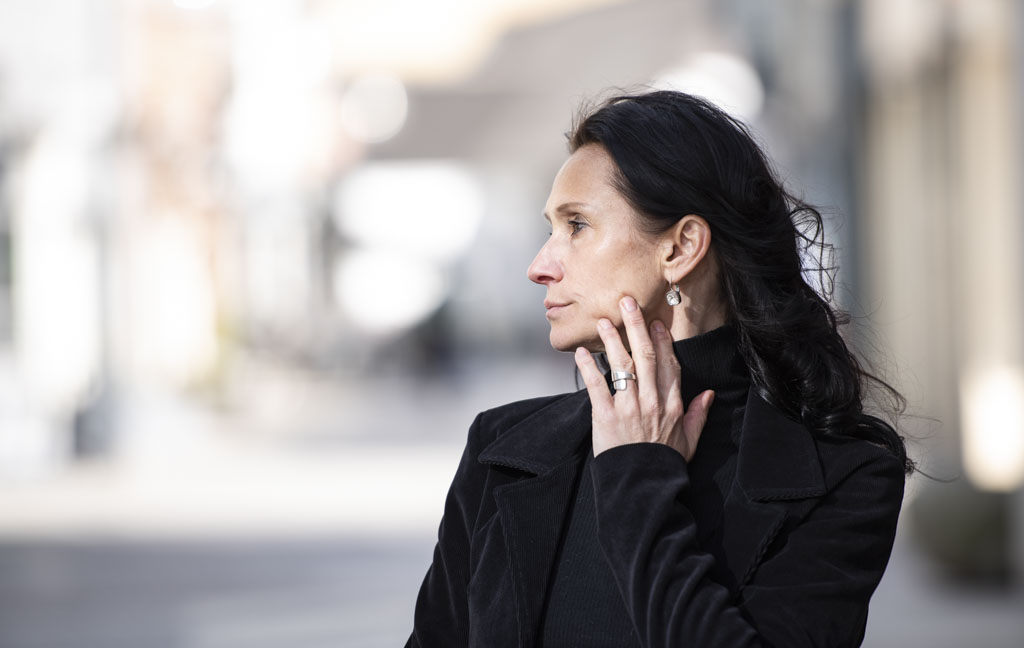
Ilze Rudzite (1972) was born in Latvia and lives and works in Denmark since 2008. In 1999, she graduated from the Textile Art Department of the Art Academy of Latvia, obtaining a master’s degree. She learned more about textile design with her studies in Denmark, on the Department of Textile Design, VIA University College (2012 – 2015).
In 2022 Ilze has completed two educations, one at the well-established Kolding Design School in the area of ‘Design Thinking for Educators’. The other is in “Craft Psychology” with the founder (Dr. Anne Kirketerp) of this new field that mixes working with crafts as a method for better mental balance and well-being.
Her works have been exhibited in Latvia, Denmark, USA, Ukraine, China and Germany. Ilze Rudzite is a member of many associations and added recently the IAPMA (The International Association of Hand Papermakers and Paper Artists) and the LDS (The Latvian Designers’ Society).
Artist’s Statement
For the last two decades, my work has been related to an aesthetic search for identity embodied in substance–fibre artworks, uncovering sublevels, such as cultural, environmental, social and existential. The works reflect on fluctuation and transformation of identity and are created in a dialogue with nature, its structures and abstract patterns. The articulation of visual language has arisen in searching for answers to existential questions about belonging, and national and cultural identity, in conditions that challenge and limit.
The fibre works are characterized by a subjectively constructed message, which is revealed through the diversity of the material and the unlimited amplitude of colours and shapes. Encoding the message, the chosen materials take a significant role, both natural and recycled. The materials from nature are collected during meditative journeys and preserved in the studio. There occurs a gradual acquaintance and communication, inspiring new ideas. In contrast, recycled materials challenge the revival of old materials encoding other functions, messages and visual forms. The combination of materials enlarges the expression of visual language, developing a broad spectrum of a colour pallet from achromatic and subdued pastel shades to bright titillating tones. The materials provide unlimited possibilities for textures and forms to become a part of two-dimensional and three-dimensional works.
I work with a sustainable art concept which respects the material’s relationship with environmental ecology. In contrast to ready-made art, this approach to sustainable art does not preserve the form of a primary object. The primary object is being deconstructed for the implementation of new ideas.